
3. Ebooks
E-books are powerful lead generators for brands hoping to grow their email marketing subscriber list or boost engagement opportunities for their sales teams.
E-books can be offered as a free digital download, provided as gated content to premium subscribers, or offered on marketplaces like Amazon to establish brand authority for a company CEO.
Use e-books when you want to offer in-depth or background information, when your audience isn’t time-constrained, or when you want to move past the building awareness stage and help guide potential customers deeper into your sales funnel.
Try This: Create an ebook on a topic that matters to your potential customers. Let people download the ebook by providing their name and email. Reach out to these people with targeted marketing advertising your products or services.
For example, we partnered with Convince and Convert to create an ebook on how to develop effective SEO strategy. When you create an ebook, be sure to also create a dedicated landing page with the gated ebook.

Types of Visual Content
In this digital era, it’s important to embrace all forms of content to help your brand stand out. Text-based content will always play a part in digital marketing, but creating and promoting visual content can bring huge benefits when you get it right.
There are three main advantages of using visual content:
- It’s more attractive. Press release distribution company PR Newswire found that including photos, videos and other visual media in press releases attracted 77 percent more views than text-only content.
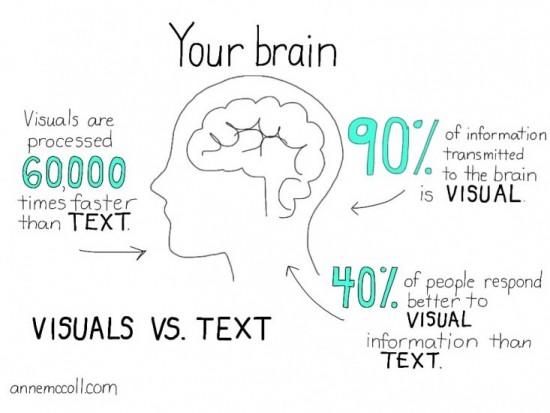
- It’s more accessible. We can process visual information 60,000 times faster than textual content.
- It’s more memorable. According to Brain Rules by Dr. John Medina, you’re six times more likely to remember information if visuals are attached.
14. Images
According to a study by Venngage, images are the most frequently used type of visual content.

While people may overlook a block of text, an image can communicate your message in a few seconds. You can find free stock photography images on sites like Flickr and Photobucket, but to make your social media and blog posts more memorable, create original images.
15. Video
Cisco predicts that videos will make up 80 percent of all global Internet traffic by 2019.
Evernote has always made good use of video on its website and across social media. The brand’s detailed explainer videos educate users about their tools, and its website also features various videos of customer stories.

How-to product videos, behind-the-scenes coverage, customer testimonials or employee interviews are a good place to start. Try to include a call to action that encourages viewers to take the next step, depending on your marketing goals.
16. Infographics
According to the Nielson Norman Group, infographics are “liked” and shared on social media three times more than any other type of content.

Pointvisible’s Content Marketing Statistics and Trends: 2017 Edition is a great example. Using bold graphics, they demonstrate the importance of content marketing using detailed stats and facts, but in a visual way that’s easy to follow.
Pull together some stats and interesting facts promoting the benefits of your company, and create your own infographic using tools like Canva or PicMonkey. You can then distribute this via your website, social media channels and email.
Related: 5 Reasons Why Your Readers Will Love Your Infographics
17. Memes
Memes are ideal for Twitter and Facebook and are easy to create. Think about your target audience and what they’ll find amusing or inspiring.
Grammarly is a great example of a company using memes well.

Their Pinterest page also features sharable “Grammarly cards” that promote their tool and the importance of good grammar.
18. GIFs
GIFs are perfect for sharing fun, light-hearted content. Twitter has made it easy to add GIFs to tweets, with a built-in option that lets you attach a GIF based on your chosen phrase
You can also create your own GIFs with GIF Maker by Giphy or And Then I Was Like, which helps you turn webcam video into a shareable GIF. You might already have video content that you can repurpose into a GIF.
19. Screenshots
With a screenshot, you can show your audience how your product or service works. You could also add marketing copy or a testimonial to the screenshot for added credibility. Have you read a testimonial or review from an industry forum about your product? Why not take a screenshot and include it in future content?
20. 360-Degree Video
Not every video is suited to the 360-degree makeover, but if it helps to highlight your brand in an interesting way, you could give it a try.
Visit Las Vegas uses 360-degree videos to give viewers virtual experiences of trademark Vegas scenes, from party events to a zip line over the Las Vegas Strip.Related Reading: Long-Term SEO Strategies to Increase Sales on Amazon
What unique experiences can you offer your audience with 360-degree video? For help with creating these interactive videos, see this article from HubSpot.
21. Magazines
One of the more recent types of visual content that has been gaining popularity are online magazines(“e-magazines”). Similar to the physical magazines we’re all familiar with, online magazines look to combine big, powerful imagery with interesting stories and snippets.
Red Bull, Harry’s and Fujitsu are all examples of companies that come out with their own magazines.

Types of Video Content
28. Product Demonstrations
Product demo videos are a fantastic way to show your product in action while also making potential customers feel like they are getting an exclusive inside look.
Demos tend to highlight key features and answer common questions to get shoppers to see how they can get value and move them closer to buying.
29. Vlog
If you’ve been creating high-quality content for your blog, why not put it in a video format as well to give your audience a wider variety of ways to consume your insights.
These are some of the easiest types of videos to produce and they tend to get high engagement.
If you’re not sure where to begin, take some cues from some of the top YouTube celebrities who have been able to capture and hold the attention of wide audiences.
30. Company Culture
A major goal of content marketing is to showcase the vibrant, human side of your brand. One of the best ways to do this is to give viewers a peek at your company’s employees and culture. You don’t need to have a quirky, Google-esque culture to make this work.
Company culture videos can include interviews with employees, company parties, birthday celebrations and more. The key is to show that your company isn’t a faceless entity but a mosaic of real people and personalities.
31. How-To Tutorials
People tend to be visual learners and how-to tutorials are some of the most sought-after videos on the Internet.
In fact, the number of YouTube searches for tutorial videos soared by 70% in 2015 alone.
Providing helpful instructions and tutorials builds long-lasting customer loyalty and it also reaffirms your credibility and product knowledge.
32. Webinar
A webinar can be a highly effective way to engage with your audience, especially for marketers in the B2B realm.
In fact, a report from the Content Marketing Institute reveals that 66% of B2B marketers cite webinars as one of their most powerful content marketing strategies.
Since webinars require users to register, they can also act as valuable lead-generation tools. As an added bonus, the content from a webinar can also be repurposed into blog posts.




















































 Welcome to My Gallery - Soorya.