
WATCH: A floating piano show on a French lake for the socially-distanced audience pic.twitter.com/u4k9mY9FS2
— Reuters Asia (@ReutersAsia) July 28, 2020
JAN GAN MAN by Mr. Sékou Oumar Diarra of Mali playing India’s National Anthem on Kora, a popular traditional musical instruments of Mali and West Africa.
JAN GAN MAN by Mr. Sékou Oumar Diarra of Mali playing India’s National Anthem on Kora, a popular traditional musical instruments of Mali and West Africa.


In just six years, the UAE has built an impressive space program from scratch.
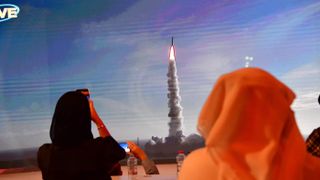
(Image: © GIUSEPPE CACACE/AFP via Getty Images)
The United Arab Emirates’ probe Hope is on its way to Mars, marking the first planetary science mission led by an Arab country.
A July 19 launch from Japan marked the start of Hope satellite’s journey to Mars. But the project (named Al-Amal in Arabic, which translates to Hope in English) has been underway for six years, since UAE president Sheikh Khalifa bin Zayed Al Nahyan announced the project in July 2014. Hope will orbit the Red Planet, collecting data on its atmosphere in order to offer scientists better information about Mars’s possible life-giving past and more barren present.
“We chose the epic challenge of reaching Mars because epic challenges inspire and motivate us,” Mohammed bin Rashid, vice president and prime minister of the country, said in a 2014 statement, as Live Science sister site Space.com reported. “The moment we stop taking on such challenges is the moment we stop moving forward.”
For the UAE, the Hope project offers an opportunity to build a more robust scientific community, to build national prestige, and to contribute directly to the global effort to uncover historical life on Mars, according to the Emirati space agency
With Tianwen-1 China aims orbiting, landing, roving on Mars in one mission
Approved by Chinese authorities in January 2016, Tianwen translates to “questions about the heavens”

Approved by Chinese authorities in January 2016, Tianwen translates to “questions about the heavens,” and has been adapted from ancient Chinese verse by poet Qu Yuan. “In ‘Tianwen,’ Qu Yuan raised a series of questions in verse involving the sky, stars, natural phenomena, myths and the real world, showing his doubts about some traditional concepts and the spirit of seeking the truth,” Xinhua reported.
 Welcome to My Gallery - Soorya.